

Why Private Hospitals Need Operating Platforms, Not Just EPRs
Why Private Hospitals Need Operating Platforms, Not Just EPRs
We’ve spent years asking whether hospitals have an EPR. I think the better question is whether their technology can actually run the hospital.
In healthcare technology, the Electronic Patient Record has become the centre of gravity. That is understandable. A good EPR is fundamental: NHS England describes an EPR as a digital version of a patient’s hospital record, including diagnoses, treatments, medications and test results; the ONC’s Base EHR definition includes patient demographic and clinical information, clinical decision support, order entry, quality information and information exchange capability.1 2
But for private hospitals, the patient record is only one part of the operating model.
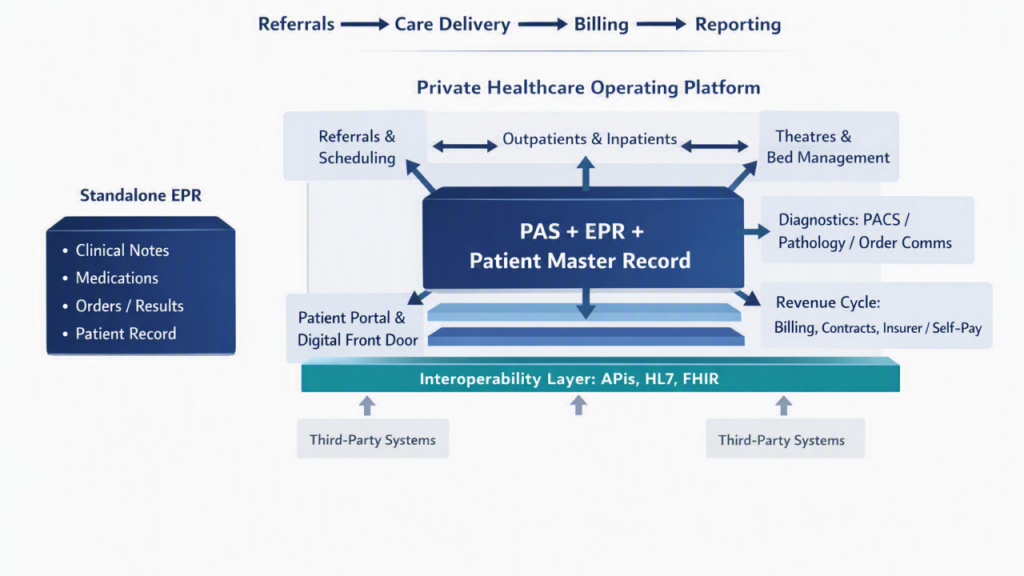
A private hospital is not just a place where clinical information is recorded. It is a complex service organisation. It has to manage patient access, consultant availability, outpatient scheduling, inpatient admissions, theatres, diagnostics, medicines, billing, insurer and self-pay journeys, reporting, patient engagement and commercial performance.
In addition, one of the biggest differences between NHS and private providers is that every clinical activity has a financial consequence. That is why I believe the next phase of private hospital technology is not simply “better EPR”. It is the move towards connected operating platforms.
The distinction matters.
An EPR answers an important question: what do we know clinically about this patient?
Yet the patient record is only one part of running a hospital. Hospitals don’t operate in records; they operate through interconnected workflows. An operating platform therefore needs to answer a much broader set of questions:
- How did the patient enter the pathway?
- What needs to happen next?
- Which clinician, room, theatre, bed, or diagnostic service is required?
- Has the activity been captured accurately?
- Is the billing pathway clear?
- Is the patient informed and engaged?
- Can management see what is happening across sites?
- Can the organisation report safely, accurately, and transparently?
That wider workflow matters because revenue cycle management in healthcare starts at the initial appointment or encounter and runs through registration, benefits verification, care delivery, claim submission, reimbursement and final payment.4 In UK private healthcare, billing is also operationally important and time-consuming; Healthcode describes billing as one of the most important tasks and notes that it can be very time-consuming.6
Private healthcare also has a transparency and reporting dimension that should not be treated as an afterthought. PHIN describes itself as a government-mandated, independent organisation publishing information about the safety, quality and costs of private healthcare.7 8 Across the UK, hospitals providing privately funded healthcare, including NHS hospitals, are required to submit data to the Private Healthcare Information Network. For healthcare leaders, whether CEO, CFO, COO, CIO or a clinical executive, this makes data quality, governance and workflow discipline strategic priorities at board level.
This is where interoperability becomes critical.
HIMSS defines interoperability as the ability of different information systems, devices and applications to access, exchange, integrate, and cooperatively use data in a coordinated manner across organisational boundaries.3 FHIR is an HL7 standard for exchanging healthcare information electronically, designed to help represent and share information in a standard way even where local EHRs represent or store data differently.9
In other words, the objective is not simply to move data from one system to another. The objective is to make the data usable in the workflow where decisions are made.
That is the real difference between a standalone record system and an operating platform.
A private healthcare operating platform should not be a closed system that attempts to do everything. Hospitals will always rely on specialist tools for imaging, pathology, pharmacy, payments, analytics, finance, patient communications, and emerging AI applications. The challenge is not replacing these systems but connecting them through an operating layer that understands the patient journey, commercial workflows, and clinical context.
The wider market appears to be moving in this direction. InterSystems TrakCare positions itself as a comprehensive EHR designed to support both clinical and business outcomes, with interoperability through HL7 FHIR and APIs alongside revenue cycle management capabilities.10 MEDITECH Expanse similarly describes itself as a cloud-native EHR that combines clinical and financial workflows with interoperability, patient engagement and partner extensions.11
The same trend is evident across other healthcare technology providers. Dedalus argues that traditional systems of record can no longer keep pace with modern engagement systems, positioning its DC4H platform around integration, data ingestion, insight, FHIR-based APIs and clinical or operational decision support.12 Oracle Health takes a similar approach, describing an integrated revenue cycle spanning patient registration through to billing, patient accounting and payment collection. 13 14
Even vendors that continue to lead with EPR or practice management messaging increasingly emphasise end-to-end operational workflows. IMS MAXIMS highlights capabilities spanning patient administration, flow, order communications, scheduling, theatres, bed management and mobile clinical apps.15 Lumeon focuses on care orchestration, automating workflows while connecting in real time with EHRs and other systems.16 Semble likewise positions itself as a connected healthcare management platform, combining for private healthcare, combining practice management, EHR and intelligent workflows.17
That does not mean every private hospital should buy the biggest possible enterprise system. In many cases, that would be the wrong lesson. The lesson is that boards should stop buying acronyms and start buying operating capability.
The better questions are:
- Can we see the patient journey from referral to discharge and payment?
- Can clinical, administrative, and finance teams work from the same operational truth?
- Can we reduce duplicate entry and manual reconciliation?
- Can we connect specialist systems without creating another integration problem?
- Can patients self-serve where appropriate?
- Can managers see live operational and financial performance?
- Can we scale across multiple sites without reinventing the workflow every time?
As CEO of Streets Heaver, and after 27 years working alongside private hospitals through successive waves of digital transformation, I naturally see this through the lens of private healthcare software. The Compucare System has evolved to combine clinical workflow management, electronic patient records, patient administration, scheduling, revenue cycle management, reporting and patient engagement into a single hospital management platform.
I am not suggesting any one supplier has all the answers. Healthcare is simply too complex for that. But after 27 years in this sector, I am convinced that private hospitals need to think beyond “record keeping” and towards “operating capability”.
The EPR remains essential. But the future belongs to providers that can connect the record to the reality of running the hospital.
Because exceptional care is what people see.
A connected operating platform is increasingly what makes it possible.